


The finance team had a secret. Their company had bought them an AI tool as part of a transformation the executive team was pushing hard and, by the time I got involved, frustrated about. The dashboards said the tool was being used. The promised gains weren’t showing up.
It took a while to see why. The team didn’t trust the tool’s outputs. But they were still the ones certifying the numbers. So they had built a shadow layer of spreadsheets and manual checks, off the books, to verify everything before it went upstairs. They were doing the work twice: once with the tool, once to check the tool.
Leadership read this as resistance. Up close, it looked like the opposite. These were people trying to stay answerable for work they no longer controlled.
Nobody in this story was behaving badly. The executives wanted efficiency; the team wanted accurate numbers. The design made those goals compete.
The deal inside every job
Jobs have always come with an implicit deal, so basic we rarely say it out loud: you answer for what you control. A chef owns the plate because she runs the kitchen. An analyst signs the model because he built it. Responsibility and control go together, and when they do, accountability feels fair. It might even feel good.
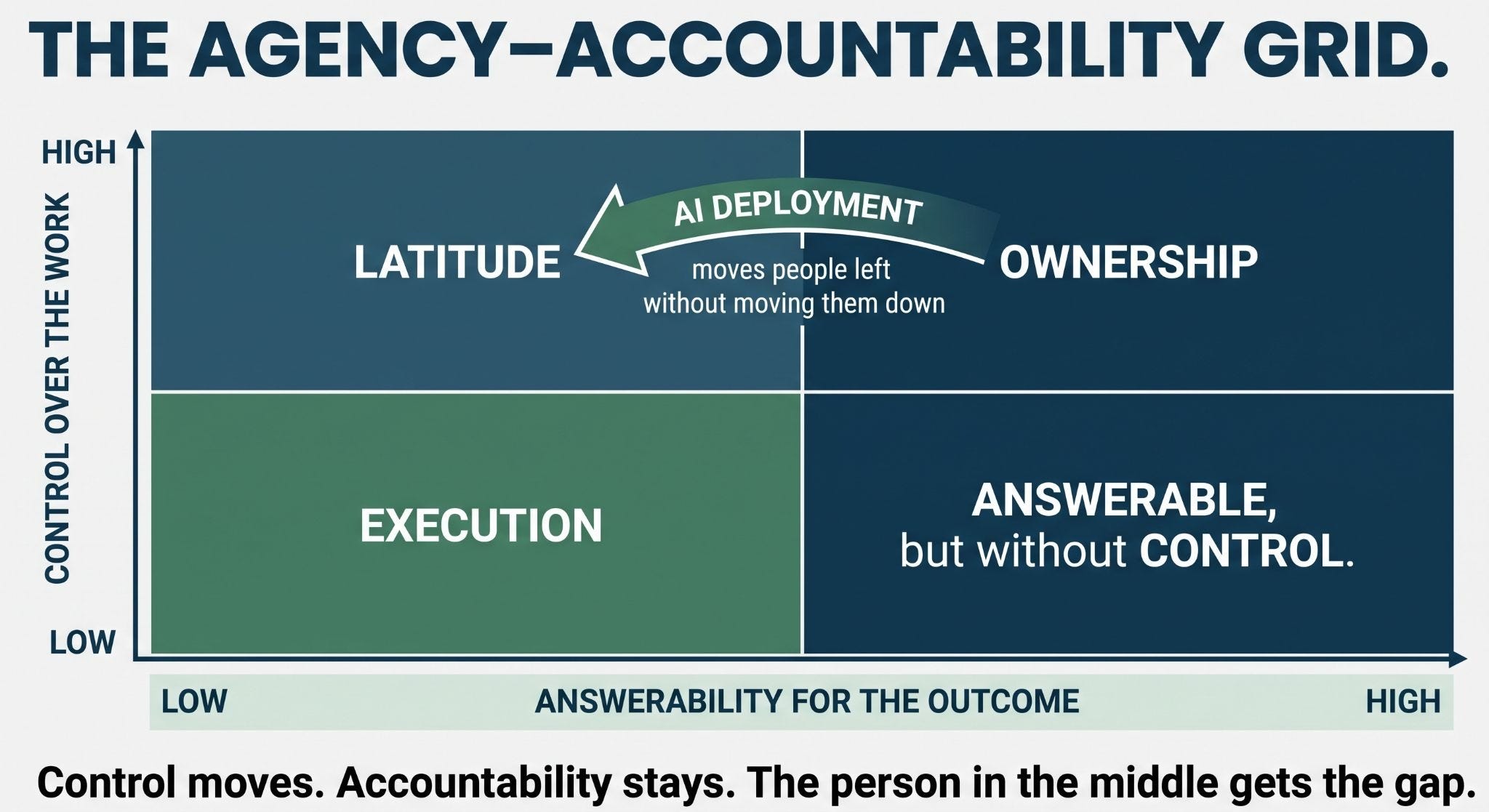
AI adoption is breaking that deal in one direction. Control over the work is moving to the tool: how the analysis runs, what the first draft says, which anomalies get flagged. Answerability is staying with the person. The regulator still wants a human signature. The client still calls a human when something is wrong. The performance review still has one name on it.
Control moves. Accountability stays. The person in the middle gets the gap.
We’ve known about this gap for fifty years
None of this should surprise us, because the strain it produces is one of the best-documented findings in work psychology.
In 1979, Robert Karasek published a model of job strain with a result that has held up for decades: what wears people down isn’t demanding work. It’s demanding work combined with low control. High demands plus high control tends to produce growth: challenge, learning, even health benefits. High demands plus low control produces strain, and research in this tradition has linked that combination to outcomes as serious as heart disease.
Later research broadened the picture. The job demands-resources model, the framework behind much of what we know about burnout and engagement, sorts every feature of a job into two piles. Demands cost energy: workload, pressure, complexity. Resources fuel motivation and buffer the demands: support, feedback, and, near the top of the list, autonomy. The model’s two headline findings map onto our moment uncomfortably well. Strip resources while demands hold, and exhaustion rises. And the same resources that protect people from burning out are the ones that drive engagement in the first place.
Now look at what an AI mandate without agency does. It raises demands: new tools to learn, faster cycles, output to verify. And it removes a resource: the ability to decide how the work gets done. Both piles move in the wrong direction at once.
There’s a third piece, from performance science. John Campbell spent a career showing that performance has just a few direct determinants: knowing what to do, knowing how, and motivation. And in his model, motivation is made of choices: whether to put in effort, how much, and how long. Choices need space. When the space shrinks, we’re acting on one of the few direct causes of performance we know of.
Three separate literatures, one conclusion: control isn’t a perk. It’s load-bearing.
How the gap gets built
Here’s the part I find most uncomfortable, having been on the leadership side of these decisions. The gap gets built by default.
The agency side gets set casually. A tool gets procured, and its design determines how much a person can inspect, override, or redirect. A workflow template hardcodes the human’s role. In the fall of 2025, 64% of the 950 workers we surveyed said their organization required them to use AI tools to do their work. Required, not offered. And that was a year ago.
The accountability side, meanwhile, can’t move casually, and mostly doesn’t move at all. Professional standards, regulators, clients, and org charts all keep a human on the hook. The researcher Madeleine Clare Elish has a name for the extreme version of this: the moral crumple zone. In a partly automated system, the human is retained less to control outcomes than to absorb blame when something fails. The car crumples so the passenger doesn’t; the human crumples so the system doesn’t.
Data from that same study shows the milder, everyday version. Among the workers required to use AI, four in ten said their organization’s performance expectations were unchanged, lagging, or only inconsistently updated to reflect how AI had changed the work. Sit with that arrangement for a moment: the tool is mandatory, and the scoreboard is stale. You must work in the new way. You’ll be judged by the old one.
Workarounds are the tell
Once you know to look for it, the agency-accountability gap has a signature: workarounds.
The shadow spreadsheet. The off-books double check. The manager who re-reads every AI-drafted client email. The team that runs the mandated tool, then redoes the work the way they trust. From the outside, these look like resistance, and they get managed like resistance — more training, more change communications, sometimes a sterner mandate.
But watch what the workarounds actually do. Nearly all of them add verification. They put human judgment back between the tool and the consequence. That’s not people rejecting the future. That’s people repairing, at their own expense and on their own time, the accountability structure their organization broke.
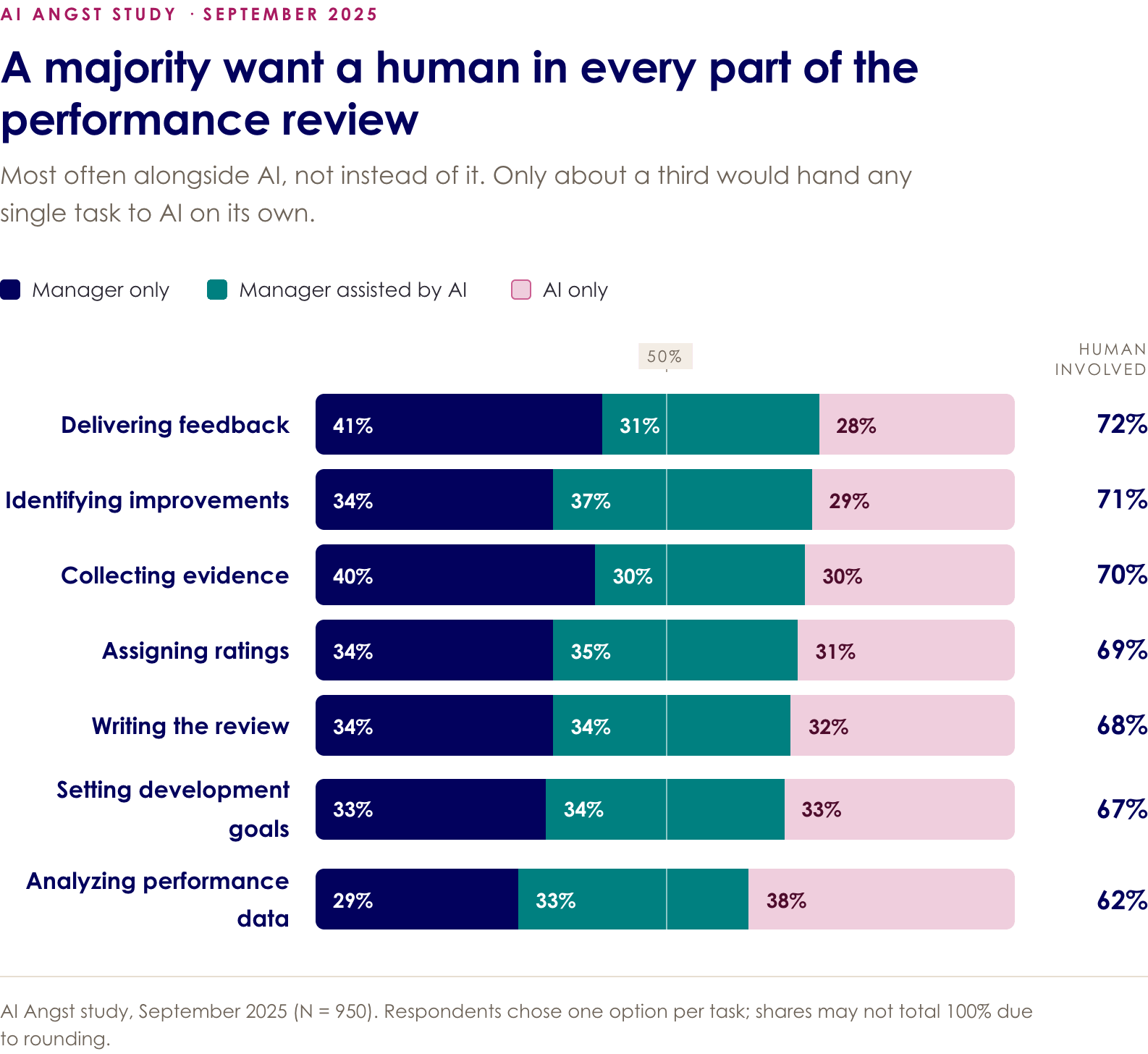
Seventy-three percent of the workers surveyed agreed they trust AI recommendations more when a human is involved. When we asked who should handle each part of their own performance evaluation, from collecting the evidence to delivering the feedback, a majority wanted a human involved in every single task. Not instead of AI; often alongside it. But involved.
And before anyone concludes that workers just want to keep control of everything: they don’t. When Stanford researchers asked 1,500 workers, task by task, what they wanted AI to take over, workers welcomed full automation for nearly half the tasks. People are happy to hand off work they don’t want to answer for. What they hold onto is the work they do.
That is a remarkably rational pattern. It’s almost as if people are telling us exactly which work they expect to answer for.
The design rule
If the diagnosis is a gap, the fix is to move the two sides together. For any task an AI touches, there are two honest options.
Raise agency to match the accountability. If a person answers for the output, they need the means to stand behind it: the ability to see how it was produced, to check it against something, to override it, and to say no without penalty. This costs speed. It is also, by our respondents’ own account, what makes AI trustworthy.
Or move the accountability to match the agency. Sometimes automation is the right call, and the honest version transfers answerability along with the work: to the vendor through liability terms, to the company through error budgets and audit trails, to whoever set the dial. If the tool decides, the tool’s owner answers. This costs something too: executives have to own outcomes they used to be able to attribute downward.
What organizations mostly do instead is the third thing: automate the work, keep the person answerable, and call the resulting friction a change management problem. That’s the crumple zone. It’s cheaper than either honest option right up until your best people burn out, build shadow systems, or leave. The transformation stalls without ever producing a villain.
Four questions
If you want to find the gap in your own organization, you don’t need a survey. Four questions will do.
Where are people accountable for outputs they can’t inspect or override? Where do workarounds cluster? For each AI-touched task, who actually decided how much control the human keeps: a person, or a procurement default? And when the AI is wrong, who answers, in policy and in practice?
I’d bet the answers to the first two questions point at the same places.
I’ve been on both sides of this. I’ve certified work I had incomplete control over, and I’ve made rollout decisions without once framing them as decisions about other people’s agency. It didn’t feel like a design choice at the time. That’s exactly why it needs to become one.
The last century of work psychology can be compressed, unfairly but not inaccurately, into one sentence: people can carry heavy loads when they hold the controls. We are now running a very large experiment in what happens when we hand people heavier loads and fewer controls at the same time.
Where in your organization has accountability already come apart from agency? Who’s holding the gap? I’d rather we design our way out of that experiment than wait for the results.
References
Bakker, A. B., & Demerouti, E. (2017). Job demands-resources theory: Taking stock and looking forward. Journal of Occupational Health Psychology, 22(3), 273–285.
Campbell, J. P., & Wiernik, B. M. (2015). The modeling and assessment of work performance. Annual Review of Organizational Psychology and Organizational Behavior, 2, 47–74. https://doi.org/10.1146/annurev-orgpsych-032414-111427
Demerouti, E., Bakker, A. B., Nachreiner, F., & Schaufeli, W. B. (2001). The job demands-resources model of burnout. Journal of Applied Psychology, 86(3), 499–512. https://doi.org/10.1037/0021-9010.86.3.499
Elish, M. C. (2019). Moral crumple zones: Cautionary tales in human-robot interaction. Engaging Science, Technology, and Society, 5, 40–60. https://doi.org/10.17351/ests2019.260
Karasek, R. A. (1979). Job demands, job decision latitude, and mental strain: Implications for job redesign. Administrative Science Quarterly, 24(2), 285–308. https://doi.org/10.2307/2392498
Shao, Y., Zope, H., Jiang, Y., Pei, J., Nguyen, D., Brynjolfsson, E., & Yang, D. (2025). Future of work with AI agents: Auditing automation and augmentation potential across the US workforce. arXiv. https://doi.org/10.48550/arXiv.2506.06576
Fractional Insights (2025). AI Angst study, September 2025 wave (N = 950). Unpublished data.
I love your integration of the models. Dare I say that psychological safety was a missing resource as well.