


What will AI do to work? Every week brings a fresh answer, each with a number attached. Eighty percent of workers have tasks exposed to large language models. Forty-nine percent of jobs could use AI for a quarter of their tasks. LinkedIn counts 1.3 million new AI-era jobs, even in a slow hiring market.
In June, a report caught my attention because it didn’t lead with a number. Commissioned by the National Center for O*NET Development (the keepers of the U.S. government’s occupational database), a team at HumRRO (Putka, Voss & Lewis) reviewed nineteen major studies of AI’s impact on work, from OpenAI’s exposure research to Anthropic’s Economic Index. HumRRO is known for its technical rigor, which I saw first hand thanks to spending the first half of my career there.
They asked a question I wish more of us would ask: what model of work are these studies actually using?
Most of them, it turns out, share the same assumption. I’ll come back to it, because it’s hiding inside nearly every AI exposure number you’ve read.
Their instinct is right. It just doesn’t go far enough. Before we measure what AI does to work, we should be honest about something the whole conversation skips: we’ve never fully agreed on what work is.
What is work?
Try to define it. It’s harder than it sounds.
One of the cleanest recent attempts comes from Adam Grant and Marissa Shandell in the Handbook of Social Psychology: work is “effort people expend in exchange for financial compensation.”
No offense to Adam, but that definition has always felt too narrow to me. A parent raising children isn’t working? Someone giving their Saturdays to a food bank isn’t working? It doesn’t sit right.
The definition I’ve been using instead: work is expending effort to create value for yourself and/or others.
The anthropologist James Suzman goes further. He spent nearly thirty years with the Ju/’hoansi of the Kalahari, and his book Work: A Deep History, from the Stone Age to the Age of Robots defines work similarly: purposefully spending energy toward an end. What his long view adds is a timeline. For roughly 95 percent of human history, work had nothing to do with employment. Hunter-gatherers met their needs on the equivalent of a short modern workweek and spent the rest of their time living. Agriculture tied work to scarcity and to worry about the future. Cities and industrial firms tied it to something newer still: the job — titled, salaried, bounded.
And here’s what my own field keeps rediscovering from the other direction: humans are wired to work. Lottery winners keep working; retirees mentor and volunteer; the whole psychology of intrinsic motivation says we seek purpose, especially social purpose, well past the paycheck. Keynes predicted that by now productivity gains would have us working fifteen-hour weeks. We hit the productivity numbers. We kept working.
So work is old, human, and much bigger than employment. The job is a recent packaging technology: a way to bundle work so it can be assigned, priced, and managed. Useful? Enormously. But it is packaging, and packaging can be redesigned.
What is a job? (Not the same as what people do in one.)
Sharpen the definition of a job and it splits into two things the AI conversation keeps collapsing into one.
A job is an organizational artifact: tasks and responsibilities bundled so that work can be handed to one person, priced in a labor market, and managed inside a structure. The bundle is a design choice. Organizations draw job boundaries differently around the same underlying work, and redraw them when they must.
But a job describes how work is organized. It says nothing about what a person actually does or contributes. For that, my field uses a different construct with a century of science behind it: job performance — the behaviors through which someone creates value in a role. The distinction matters more than it seems, because AI-impact studies are trying to answer a performance question (what parts of what humans do can AI do?), typically using only the paperwork of work organization: task statements in an occupational database.
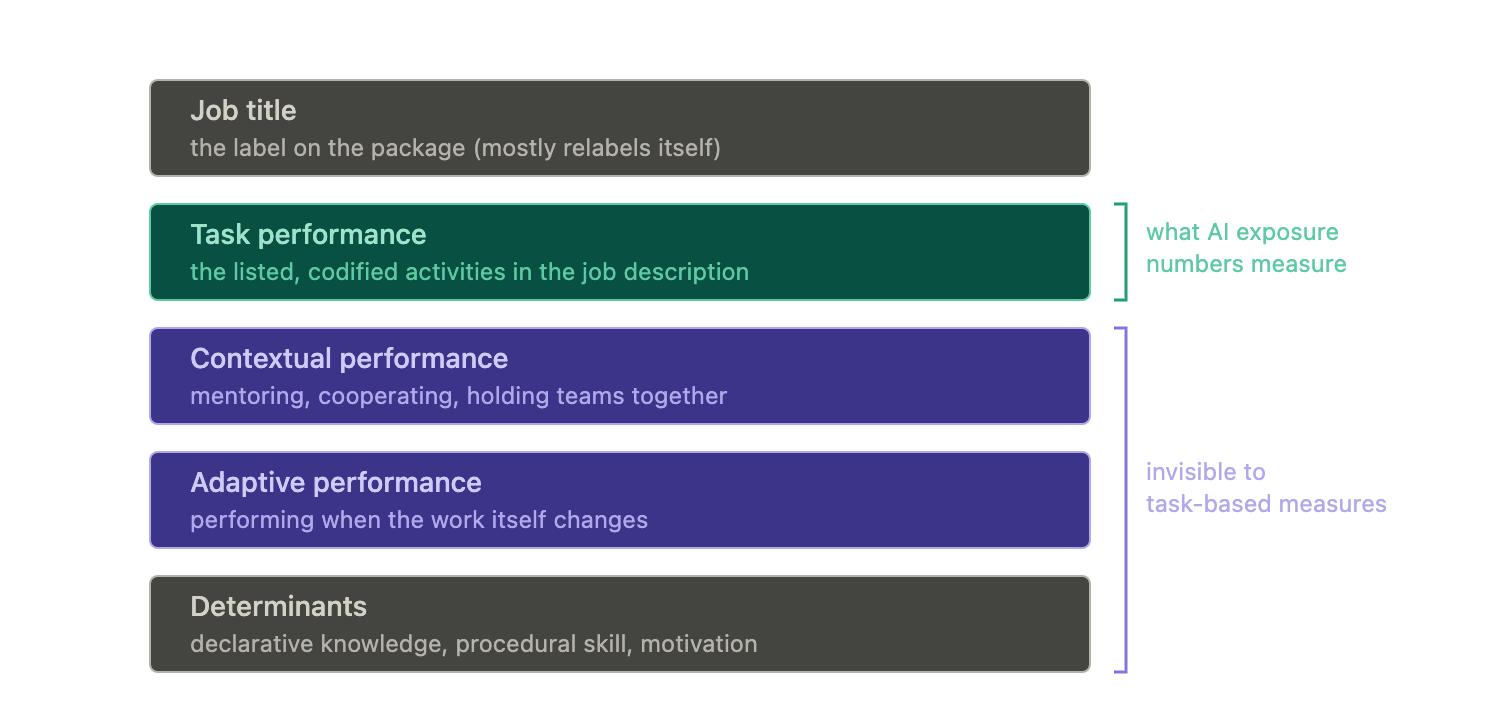
And performance science settled long ago that what people do exceeds what the task list says. The classic model (Borman and Motowidlo) separates task performance, the formal listable activities, from contextual performance: mentoring a newer colleague, cooperating across teams, volunteering for what needs doing, holding together the social fabric that makes the formal work possible. Underneath both sit the determinants — the declarative knowledge, procedural skill, and motivation that produce performance in the first place.
(There’s a third family the field recognizes: adaptive performance, how well people perform when the work itself changes. Organizations have mostly left it unspecified. The exceptions are instructive, such as special forces selection, which treats adapting as the job. In an era when task lists get rewritten in real time, I suspect it’s the performance domain we’ll come to care about most.)
So even before AI, inferring a job’s exposure from its task list was doubly incomplete. The task list captures one slice of performance, and performance is not the package it comes wrapped in. The task list is simply the visible layer: easiest to write down, easiest to standardize, and, not coincidentally, easiest to hand to a research team or a language model.
The assumption in the numbers
Back to HumRRO. Sixteen of the nineteen studies they reviewed draw on O*NET data — the government’s database of job characteristics, worker skills, and detailed occupation profiles. And they found that the majority take a task-centric view of job performance —performance: a lens inherited from labor economics and computer science, with almost no connection to the scientific literature where job performance has been studied for the past hundred years.
Nearly every exposure percentage you’ve seen was produced the same way: take an occupation’s task statements, score what AI can do against them, add it up. The contextual layer isn’t in the data. The knowledge and skill beneath the tasks are barely in the data. The interdependencies among tasks, the ways a job is more than the sum of its parts, are not in the data.
The authors expect AI’s impact on contextual performance to be far lower than its impact on task performance. If they’re right, the headline numbers systematically overstate how much of a job AI reaches. Not because the studies are sloppy. Because they inherited a model of work that was incomplete. The measurement was faithful to the task list. The task list was never faithful to the job.
The report’s constructive proposal is a suite of sixteen new AI-impact indices for O*NET, sorted by which layer of performance is measured, at what unit of analysis, and whether the impact is automation (AI does the work independently) or augmentation (AI assists while a human stays responsible). Most research treats those as points on one spectrum. HumRRO treats them as different phenomena that need separate measurement.
If you spend your days thinking about how work gets valued, that distinction is anything but academic. An automated task and an augmented task probably shouldn’t be trained for, governed, or paid the same way and the job evaluation and skills-based pay systems most organizations run today can’t see the difference. Today’s studies count both as “AI touched this.”
Why the layers matter
Once you see them, some apparent contradictions in the data resolve.
OpenAI’s analysis of 800,000+ ChatGPT conversations found that 43.5 percent of occupation-specific AI use involved tasks that historically belonged to a different occupation: people absorbing work that used to require a handoff to a specialist. Anthropic’s labor market research, meanwhile, finds the actual distribution of jobs has barely moved. Task-level turbulence. Job-level calm.
If a job were its task list, that would be a paradox. If what people do at work is task performance plus contextual performance plus the capabilities underneath, it’s roughly what you’d predict. AI is reorganizing the most codified layer of work first, while the layers that were never task statements — the judgment, the relationships, the motivation — change far more slowly. The task layer is fluid. The human layers are viscous. Job titles, the crudest layer of all, mostly relabel themselves. Which is one way to read the “AI created 1.3 million jobs” headlines: many of those roles are existing jobs re-bundled around new tools and renamed. Re-bundling is real change. But counting titles tells you about the packaging, not the work.
The question before the question
Why insist on this order — definitions first, measurements second?
Because the definition decides the story. If work is only employment (effort exchanged for pay, organized into task lists), then AI is a subtraction problem, and the question is how fast the list shrinks. If work is what Suzman describes and what the motivation research keeps confirming — purposeful effort to create value, something we do even when nothing requires it — then the story changes shape. Humans won’t stop working. We’ll redefine it, the way we have through every previous transformation. Task lists will be rewritten. Some jobs will genuinely disappear. New bundles will form. And the parts of work that never appeared on any list – including how we perform when the list itself changes – may turn out to be the parts that matter most.
The open question is whether the systems we use to define, measure, and pay for work will be rebuilt to see all of it, or only the layer that was easiest to write down.
I’d genuinely like to know: what’s your definition of work? And what does your job include that has never once appeared on a task list?
References
Anthropic. (2026). Anthropic Economic Index: Labor market impacts. https://www.anthropic.com/research/labor-market-impacts
Borman, W. C., & Motowidlo, S. J. (1997). Task performance and contextual performance: The meaning for personnel selection research. Human Performance, 10(2), 99–109. https://doi.org/10.1207/s15327043hup1002_3
Grant, A. M., & Shandell, M. S. (2024). Work. In D. T. Gilbert, S. T. Fiske, E. J. Finkel, & W. B. Mendes (Eds.), The handbook of social psychology (6th ed.). Situational Press. https://doi.org/10.70400/HIBO9025
Kaplan, S. A., Aitken, J. A., Allan, B. A., Alliger, G. M., Ballard, T., & Zacher, H. (2025). Revisiting Keynes’ predictions about work and leisure: A discussion of fundamental questions about the nature of modern work. Industrial and Organizational Psychology, 18(1), 1–22. https://doi.org/10.1017/iop.2024.58
Keynes, J. M. (2010). Economic possibilities for our grandchildren. In Essays in persuasion (pp. 321–332). Palgrave Macmillan. (Original work published 1930)
OpenAI. (2026, July). Work at the frontier: How AI is expanding what people do at work. https://openai.com/index/how-ai-is-expanding-what-people-do-at-work/
Putka, D. J., Voss, N. M., & Lewis, P. (2026). Indexing the impact of AI within the O*NET system: A review of methods and development of recommendations. Human Resources Research Organization. https://www.onetcenter.org/dl_files/AI_Impact_Review.pdf
Suzman, J. (2021). Work: A deep history, from the Stone Age to the age of robots. Penguin Press.
World Economic Forum. (2026, January 23). AI has already added 1.3 million new jobs, according to LinkedIn data. https://www.weforum.org/stories/2026/01/ai-has-already-added-1-3-million-new-jobs-according-to-linkedin-data/
Great piece and thank you for being so precise in identifying what I think is a huge gap in the discourse around task and the broader conversation of "AI coverage." Every time I see one of those reports I wonder to myself about the efficacy of the baseline they are using to measure and I think you nailed it with why its worth a much deeper look.
To the credit of some of those reports, I remember listening to a podcast interview with the team that does these at OpenAI and I do believe the author noted that in addition to Onet they actually do use vetted experts across those disciplines in the report to confirm the validity of the tasks, but I have a hard time believing that even with that judgement that everything across each industry maps so cleanly. But you point to a much more important question worth asking regardless of what the percentages net out to.
Also, thank you for incorporating Suzman's work into your piece. I remember reading his book back in 2021-2022 but it was a good reminder for me to go revisit it. What struck me at the time of his reflections was just how different the people in those tribe associated to their job/work. I remember the point he made about how if you were a hunter and maybe got too much meat people in the tribe would laugh and make fun of you (in a light hearted way) for being too largesse. It felt like a lot of their defaults of the tribe were set to the collective, and having a good idea of what "enough" is, and I think today, that is something that is entirely different at least in Western Society. I think its hard to envision us going back to what was, but I wish we could be more imaginative around how some of these principles for the tribe could be incorporated in a more modern way, which would in turn, reshape I think how we collectively associate to work.
As always, such a thoughtful and insightful piece, @Shonna Waters. As you so perfectly frame - “Everyone's asking what AI will do to work. But almost nobody stops to define work first.” Yes, yes - a million times to that! 👏