


The old employment contract is dead.
Loyalty and performance yield security and growth. That was the deal and it held for decades. But today, it no longer holds, and many organizations are blissfully unaware of the consequences that will inevitably come.
Today’s model is an arrangement without terms. Workers are building side businesses, stacking roles, stockpiling savings against the next round of cuts, instead of fully committing to their roles. Companies are restructuring faster than they did two years ago, designing for agility over tenure, signaling with every decision that headcount is a variable, not an asset. Many organizations and employees are operating in “for now” mode, neither committing nor leaving.
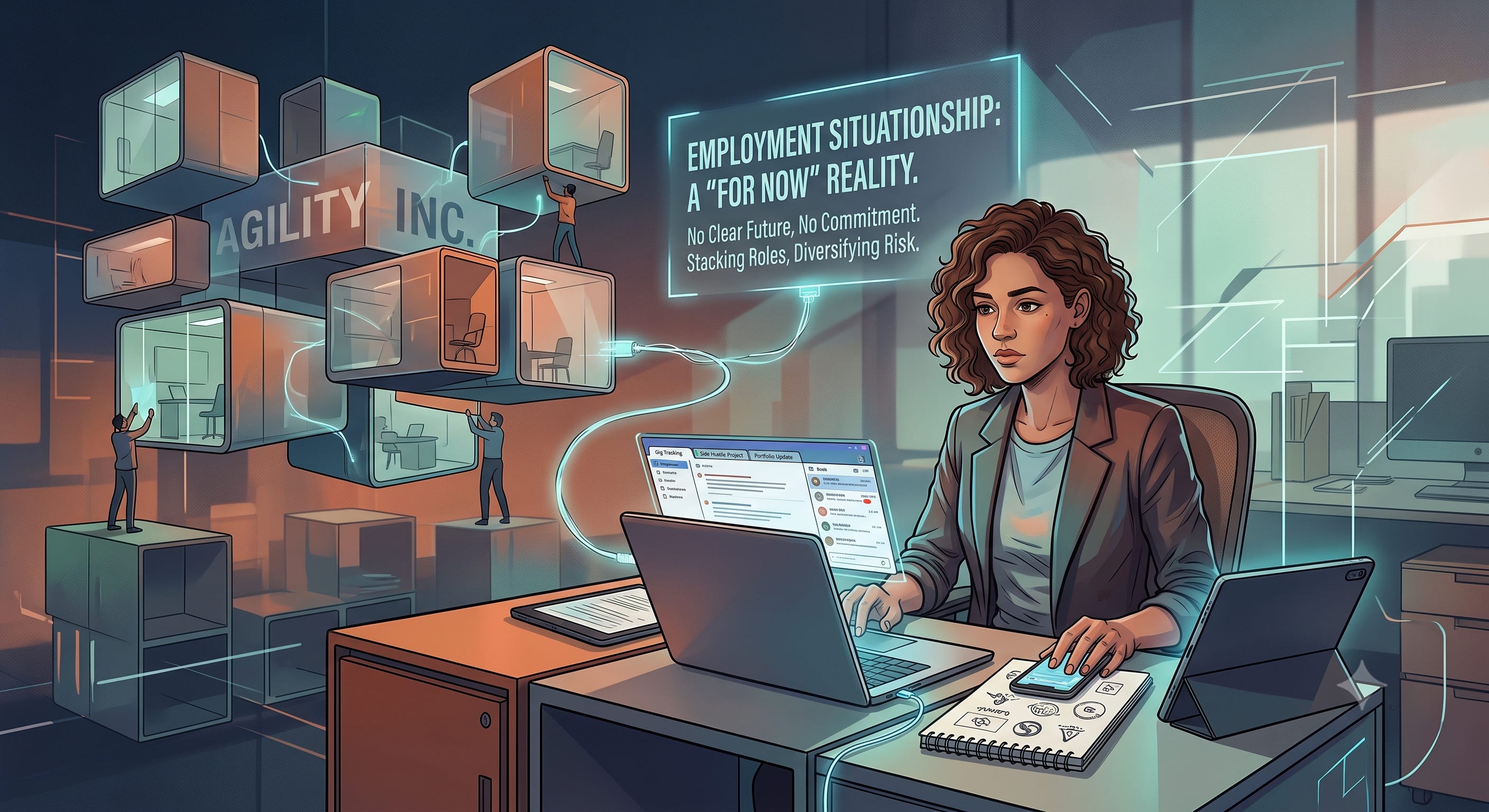
We call this employment situationship: a relationship with real stakes but no clear future. The real danger is if organizations let it harden into a permanent default rather than making a choice to design something better.
We’re headed to a transactional equilibrium where neither the employer or employee fully invests, where compliance replaces discretionary effort, and where we call it “the new normal” even though no one intentionally chose it.
Employment Situationship Violates Something Deeper Than Engagement
Employee engagement literature has frameworks for burnout, disengagement, and trust erosion. What it doesn’t fully capture is what happens when the structure of the employer-employee relationship becomes ambiguous in ways that can’t be resolved through better management or stronger culture.
The human brain is not built for this. Being part of a group you’re not loyal to, and that isn’t loyal to you, isn’t simply an uncomfortable feeling. It’s cognitively foreign. The research on motivation and belonging is consistent: humans are wired for group membership that is purposeful and reciprocal. When work requires people to simultaneously show up fully and maintain their exit strategy, the cognitive dissonance of that split creates a unique form of organizational stress.
It also forces people into a position they wouldn’t otherwise choose.
According to Fractional Insights research, about 35% of workers are “Universalists.” They are employees who seek to fulfill three core needs at work: security, growth, and significance. They are wired for deep investment, institutional knowledge-building, and long-term contribution. Within an employment system that reciprocates, their higher engagement and performance compounds over time.
Employment situationship overrides that orientation. When the structural conditions of employment communicate “for now” from both sides, Universalists adopt Transactionalist protective behaviors: hedging externally, maintaining portability, and limiting emotional investment.
This is the part that should bother leaders most. We’re not just losing engagement from people who were never that engaged. We’re actively converting our highest-potential institutional builders into short-term, self-protective operators.
The Data Makes the Costs Visible
Workplace angst affects 44% of the workforce and costs large organizations with more than 10,000 employees between $240 and $330 million annually. The situationship amplifies every one of those pressures.
Recent research from Qualtrics, examining nearly 34,000 global employees across 24 countries and all major industries, reveals how this shift is manifesting in measurable ways. Three critical employee cohorts reported precipitous drops in experience year-over-year: part-time workers, customer-facing workers, and new joiners. These cohorts represent the places where organizations are withdrawing investment, whether intentionally or unintentionally.
When customer-facing employees were asked to evaluate their company’s overall performance compared to when they were asked how well it delivers on customer experience, their responses were nearly identical. These aren’t separate assessments in employees’ minds. They’re unified.
More striking: when researchers compared the same employees’ views on the causes of poor customer experience to actual consumer feedback from 20,000+ global consumers surveyed separately, these employees were more accurate than executives. The people being treated as most replaceable carry the sharpest signal about what actually drives customer dissatisfaction. And most importantly, they’re the ones directly delivering the customer experience.
The data suggests the drift toward situationship is well underway: Employee experience metrics dropping most sharply for the populations closest to customers, companies responding to volatility by designing roles for easy replacement rather than development. A thousand small decisions, each locally rational, collectively creating a system that few actually want.
To be clear, this isn’t a problem created by the newest generation of workers. It’s a design problem.
Intentionally Redesigning for the Future
Redesigning the employment contract starts with acknowledgment of the long term costs and honesty.
We must stop pretending that all roles carry the same implicit promise. Some roles should be designed for depth, tenure, and significant organizational investment. Others are designed for shorter-term contribution, flexibility, and skills portability.
Redefine what development looks like when the ladder isn’t the model. If tenure can’t be promised, what can? Skills that transfer. Project-based progression. Transparent criteria for opportunity, even without guaranteed outcomes. Employees can adapt to change. What they cannot adapt to is the gap between what organizations say they value and what their actions reveal.
The organizations that will attract and retain genuine high investment from the people most capable of it are the ones that tell the clearest truth about the terms while creating actual space for mutual investment within those terms.
And importantly, invest in frontline, part-time, and new employees. Not because it’s the right thing to do in the abstract, though it certainly is! But because the data is unambiguous: how you invest in these populations directly shapes the customer experiences that drive business performance.
About the authors:
Shonna Waters, PhD has spent 25 years at the intersection of behavioral science and organizational strategy. She is the creator of Psychological Ergonomics™, a framework that treats workplace dysfunction as a systems engineering problem rather than a human one. She is SVP of Executive Engagement & Insights at Syndio, adjunct faculty at Georgetown University, and co-author of The Coaching Shift. She writes regularly on the future of work, AI, and how organizations redesign systems to fit the humans inside them to drive performance.
Dr. Benjamin Granger is Chief Workplace Psychologist at Qualtrics, and has over a decade of experience building, running and optimizing experience management (XM) programs across the globe. As Chief Workplace Psychologist, he leverages original research to offer insights into macro workplace trends, employee experiences, and the future of how we work.
Shonna and Benjamin: Your arguments are spot on, and I usually wouldn't feel the need to comment. However, I think you may be overlooking a reality of how the labor market has fundamentally changed over the past 3-4 decades.
You describe the old world where regular employment with benefits was the norm for most workers -- which we haven't seen in over a generation. As you know, starting in the 1980s and 1990s, we've had a steady growth in employment categories that have eroded "regular" employment: temps, contract workers/independent contracting, gig workers, etc. In addition, the aggressive outsourcing and offshoring of many jobs means that many more people who do not show up as working on the books for a company where they live, for all intents and purposes work for that company, yet with an "arms length" relationship at best, and a subclass status at worst.
So, I am not saying you are wrong. Rather, that the damage you call out has been inflicted like a thousand paper cuts over many decades. To the point that those still in "regular" employment know the deal -- that they, too, could end up like their peers who don't have the privilege of a job with benefits and the supposed dedication of the company to their wellbeing. They know that they are just as "on their own" as the people working without benefits, in gig/temp work, and/or outsourced.
Should you argue for investing (back) into employee populations that have been starved for resources, support, etc.? Of course. I just wouldn't kid ourselves about just how far companies have taken us down the current dark path. Getting back to a more sane equilibrium will take a really long time. On the positive side, the organizations that do so should find they gain a real competitive advantage.